


Mindfulness at Work: When Corporate Wellness Adds Pressure

Meditation is sold in the western world as a solution to the problem of stress. if you do enough meditation, if you train for a certain amount of hours in a specific way, then you will be sorted! Yahoo!
But mindfulness at work is more complicated than that.
Many big corporations now run internal mindfulness programmes. They talk about cultivating joy, peace, and compassion — but often because it is good for the business first, and good for the person second.
When mindfulness becomes another task
Based on this agenda you start to practice meditation. After a few weeks, you might actually really become more mindful, but the stress has not really gone away, is still there, and maybe it has increased (note: mindfulness is not a practice that aims to get rid of stress).
The next performance review is in 10 days. Tomorrow you have an early meeting at 8 am and you might stay in the office until 9 pm. You have also an approaching deadline and your manager is not in a good mood.
A thought may appear in your head: "I need to work harder with those mindfulness practices. I might not have done enough"
You have just created another task to do and target to achieve, which can very well add to your stress.
Now, let me reframe all this story in a slightly different way.
Mindfulness does not remove stress
By practising mindfulness, you can gain some head space to see and understand what is going on with you in your office environment and your life in general.
You might realize that you are even more stressed than you thought. You understand that, given the environment you work in, this is normal. Of course, you might be over-reacting to some events and this is adding another layer of stress to an already difficult situation, but surely, you can now see that at least part of your stress is not caused by your "lack of presence", joy or compassion.
The real question: what needs to change?
Ask yourself "Am I actually working in a compassionate environment where people are given precedence over numbers?"
Maybe not. Could this corporate mindfulness story be just another way to manipulate me into working harder and harder?
"You are stressed? Go on, do some mindfulness and you will be ok. We are doing our best to make the environment so good for you! Don't you see?".
When this starts to become clear, a mindful mind will ask for actions! And that action could ask you to actively do something to change the environment.
If work pressure, stress, or the need to keep coping has started to shape how you live, therapy can offer a structured space to understand the pattern and build practical psychological skills for real life.
You can start with an introductory call to explore whether this approach is a fit.
Why this matters
As an English and Italian-speaking therapist in Paris, I often work with people who look like they are coping well from the outside, but feel under pressure internally. Mindfulness can be helpful, but only when it is connected to real self-awareness, honest reflection, and practical change. Otherwise, it risks becoming another way to manage stress without questioning what is creating it.
Therapy can offer a structured space to look at these patterns more clearly — especially when work, pressure, relocation, or the need to keep performing have started to shape how you live.
A small mindfulness check for work stress
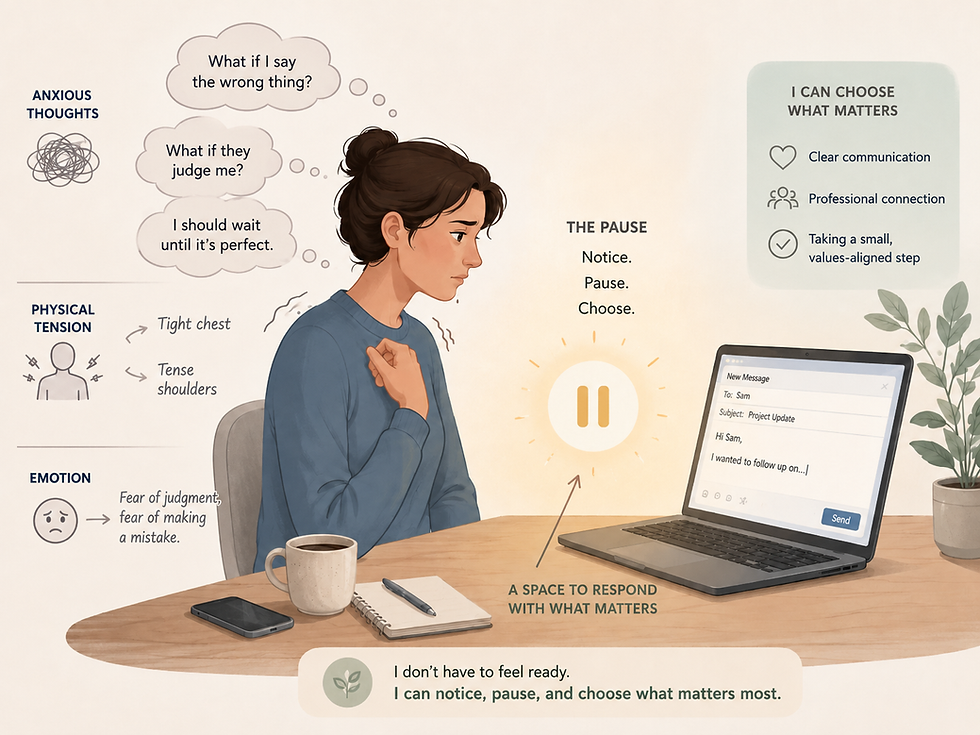
Before treating mindfulness as another task on your to-do list, pause for a moment and ask yourself:
1. What am I being asked to tolerate?Is mindfulness helping me respond differently, or is it helping me endure a situation that may need to change?
2. What does my stress keep pointing to?Is it workload, pressure, lack of support, unclear expectations, conflict, isolation, or the feeling that you always have to perform?
3. What would a compassionate response actually look like?Not just breathing through it. Not just staying productive. A real response might involve setting a boundary, asking for support, taking rest seriously, or admitting that something is not working.
Mindfulness can help you notice what is happening. But noticing is only the beginning. The deeper work is learning how to respond in a way that is connected to your values, your limits, and the kind of life you want to build.
If work pressure, stress, or the need to keep coping has started to shape how you live, therapy can offer a structured space to understand the pattern and build practical psychological skills for real life.
You can start with an introductory call to explore whether this approach is a fit.


Comments