


When Fear Gets in the Way of What Matters: The Rope Bridge Exercise
Updated: Oct 1

You want to have an honest conversation, start a course, or make a change at work. You can picture why it matters. Then your mind supplies a list of reasons to wait: What if I fail? What if I get hurt? What if I'm not ready? You decide to act when you feel more confident. A week later, you are still waiting.
At a recent webinar, I guided a Rope Bridge exercise to explore what fear does and consider a small step toward what matters.
The ACT idea: build flexibility around fear
Acceptance and Commitment Therapy (ACT) aims to develop psychological flexibility: the ability to notice what is happening inside and around us, respond to thoughts and feelings with some openness, and take action guided by our values.
Values are qualities we want to bring to our lives: connecting, learning, caring, or being honest. A goal might be to finish a course; the value behind it might be learning.
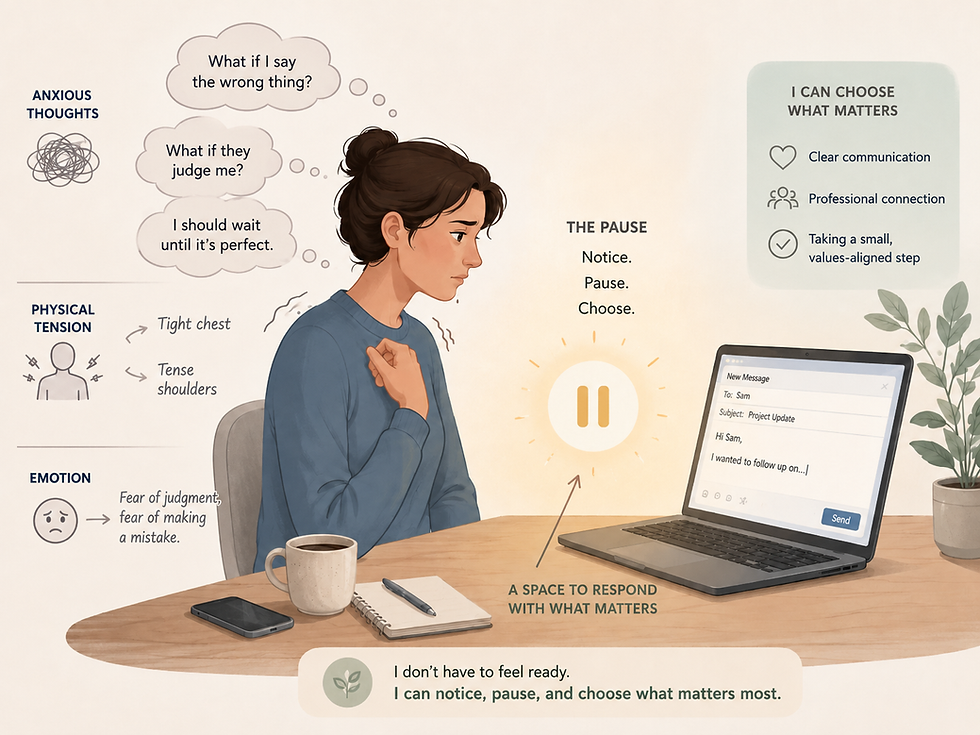
This matters when fear shows up. If my rule is “I must feel confident before I speak,” I may put off an important conversation indefinitely. ACT helps me notice that rule as a thought my mind is offering. I can check whether there is a practical concern to address, make room for some discomfort, and choose how I want to behave in the relationship.
Making room for anxiety takes practice. It means noticing the feeling and finding ways to carry it while doing something important. The measure of progress is not simply whether anxiety has fallen. We also ask whether our actions are taking us closer to the life we want to live.
Standing at the edge: the rope bridge exercise
In the exercise, I asked participants to think of something they longed for: perhaps greater intimacy, a creative project, or a new way of caring for themselves. Then I invited them to imagine standing at the edge of a deep canyon. Across it lay the life they wanted to move toward. The only visible route was an old rope bridge, with worn ropes and some missing planks.
From the cliff, they could not tell whether the bridge would hold them. One option was to stay on solid ground and avoid the risk. Another was to rush across. A third was to test the first plank carefully: one foot on the bridge, one foot on the cliff, a little weight shifted forward. Then they could notice what happened and decide on the next step.
Real-life choices need sensible judgment. A risk may call for more information, support, or another route. But when endless analysis helps us avoid uncertainty, staying at the edge tells us little. A considered action gives us something to learn from.
Why imagining the bridge can help
After picturing the first step, participants noticed the thoughts that appeared: I'll fail. It's too late. I'll be rejected. They noticed feelings, sensations, and urges to postpone or withdraw. They also looked at what “keeping both feet on the cliff” meant in their everyday behaviour.
That is where the exercise becomes more than an image. We practise noticing a thought without automatically obeying it. We recognise the urge to retreat and what retreat might cost us. We reconnect with the reason for stepping forward. In ACT, these are practical skills: stepping back from unhelpful thoughts, making space for difficult feelings, and choosing an action linked to our values.
The imagined test cannot tell us how a conversation or project will turn out. It helps us identify an experiment small enough to try: writing an email's opening line, asking for ten minutes to talk, or attending the next class after missing one. We can then see what happens and adjust.
In the discussion afterwards, people recognised different parts of this process. An old fear could colour a present-day choice. A planned first step could disappear amid ordinary demands. Starting a course could feel possible, while continuing once fear of failure returned could be much harder. These reflections reminded us that committed action often means choosing our direction again and again, with new thoughts and feelings each time.
For therapists, I find the bridge most useful as a conversation, adapted to the person in front of me. I might ask, “What is on the other side for you?” or “What would testing one plank look like this week?” Their answer helps us find an action that fits their circumstances and values.
What is your first plank?
If something important has been on hold, try asking yourself:
What matters here? Name the quality you want to bring to this part of your life.
What shows up at the edge? Notice your mind's predictions, your feelings, and your urge to delay.
What does staying put cost you? Look at the pattern with curiosity rather than blame.
What is one careful test? Choose a step you can take, learn from, and adjust if needed.
You do not have to settle every doubt before moving. You can assess the situation, take a manageable step, and build the skills to carry uncertainty as you go. That is how we begin to learn what the bridge can hold.
If fear, anxiety, or overthinking repeatedly leave you stuck, I can help you work with these patterns and build practical ACT skills. I offer therapy in English and Italian in Paris and online.


Comments