


Can You Trust AI to Help You Find a Psychotherapist in France?

AI is increasingly becoming part of how we search for information. That includes mental health.
Recently, I tried searching for an English-speaking therapist in France as if I were a prospective client. I asked an AI tool what I should look for when choosing a psychotherapist.
Among its recommendations was this:
AI BOT Wrote: “Verification Rule: Never work with anyone calling themselves a ‘Psychopraticien’ or ‘Coach’ if you require a legally regulated therapist, as these titles are unregulated in France. Always verify that your therapist lists an RPPS or ADELI number.”
It sounds authoritative. There is also some truth behind it: psychopraticien is not a legally protected title in France.
The problem is the conclusion.
Following this advice could lead someone to reject a highly trained psychopraticien while assuming that another practitioner has extensive psychotherapy training when this may not actually be the case.
And that illustrates something important about using AI to make decisions about your mental health.
⚠️ AI can sound certain even when the reality is more complicated
AI can be extremely useful for finding and organising information.
But a confident answer is not necessarily an accurate or complete one.
Psychotherapy is a particularly difficult area because professional titles, regulations and training standards differ considerably between countries.
The title someone uses does not necessarily tell you everything you need to know about their actual training in psychotherapy.
So let's look at the distinction that the AI recommendation missed.
What does “psychothérapeute” actually guarantee in France?
The title psychothérapeute is legally regulated in France.
That is important.
But there is another important part of the story.
According to the Fédération Française de Psychothérapie et Psychanalyse (FF2P), the French legal requirements for the title focus on specified professional qualifications together with theoretical training in clinical psychopathology and a practical placement.
However, the legal requirements for the title do not themselves require:
training in a specific method of psychotherapy
personal psychotherapy
ongoing clinical supervision
adherence to a psychotherapy-specific professional code of ethics
This means that being legally entitled to use the title psychothérapeute should not automatically be interpreted as meaning that someone has completed comprehensive professional training specifically in psychotherapy.
That distinction matters.
The European Association for Psychotherapy describes psychotherapy as a profession involving specialised theoretical and clinical training following an initial higher-education qualification.
In other words, legal entitlement to a title and professional training in psychotherapy are related questions, but they are not necessarily the same question.
🔎 But “psychopraticien” doesn't guarantee training either
This is where we need to be equally careful in the other direction.
Psychopraticien is not a legally protected title in France.
So simply seeing that word on someone's website tells you very little about their qualifications.
One psychopraticien could have extensive professional psychotherapy training. Another may not.
This is why the original AI advice contained a piece of useful information but turned it into an unreliable rule.
Consider the FF2P, for example. A psychopraticien recognised by the FF2P must meet substantial professional requirements, including psychotherapy training, psychopathology training, supervised clinical practice, personal psychotherapy, ongoing supervision, continuing professional development and adherence to a professional code of ethics.
The FF2P's current certification criteria include hundreds of hours of psychotherapy-specific education and supervised practice.
So rejecting such a practitioner simply because they use the title psychopraticien could make little sense.
But accepting anyone simply because they call themselves a psychopraticien would make equally little sense.
The title alone isn't enough information.
✅ How should you check the qualifications of a psychotherapist in France?
When looking for a psychotherapist in France, particularly if you are an expat trying to understand an unfamiliar healthcare and professional system, look beyond the wording of their professional title.
A practical checklist
1. Look at their core psychotherapy training
Where did they train? What qualification did they receive? Was it a substantial professional psychotherapy or counselling training rather than a short course?
2. Look at their therapeutic approach
A therapist should normally be able to explain how they work and what their training is grounded in.
That might be ACT, humanistic and integrative psychotherapy, psychodynamic psychotherapy, CBT, Gestalt, systemic therapy or another established approach.
You don't need to become an expert in psychotherapy modalities. But there should be a coherent professional training behind the work.
3. Check their professional membership or accreditation
This can be particularly useful.
A credible professional organisation usually establishes requirements around training, ethics, supervision, continuing professional development and complaints or professional-conduct procedures.
4. Check whether they follow a professional code of ethics
A therapist should be accountable to more than their own judgement.
Membership of an established professional body can provide an ethical framework and, importantly, a formal structure for professional accountability.
🌍 What if your therapist trained in another country?
This is particularly relevant for expats.
Living in France does not mean that your therapist necessarily trained in France.
An English-speaking therapist in Paris, for example, may have trained and become professionally accredited in Ireland or the UK before practising in France.
Rather than dismissing those qualifications because they do not fit neatly into a French professional title, look at the organisation responsible for setting and maintaining the therapist's professional standards.
There are established psychotherapy and counselling organisations across Europe.
In France, for example, the FF2P represents practitioners meeting its psychotherapy standards and is connected to the European Association for Psychotherapy.
In the UK, organisations such as UKCP and BACP maintain professional registers and standards for psychotherapists and/or counsellors.
In Ireland, organisations including the Irish Council for Psychotherapy (ICP), Irish Association for Counselling and Psychotherapy (IACP) and Irish Association of Humanistic and Integrative Psychotherapy (IAHIP) provide professional structures through which training and professional standing can be assessed.
You do not need to understand the entire European regulatory landscape before making an appointment.
You just need to look a little deeper.
🧠 The bigger lesson about asking AI for mental health advice
The problem here isn't that AI got everything wrong.
In some ways, that is precisely what makes this example interesting.
It identified a real fact — that psychopraticien is not a legally protected title in France — and then built a recommendation around it that was far more absolute than the evidence justified.
That is an important limitation to remember when using AI for questions about psychotherapy, mental health or choosing a therapist.
AI can help you find questions to ask.
It can help you understand terminology.
It can give you a starting point for your research.
But it should not replace checking the underlying information, particularly when an answer tells you categorically whom you should or shouldn't trust.
When looking for a therapist, check their actual psychotherapy training, qualifications, professional accreditation or membership, supervision and ethical framework.
Those details will usually tell you far more than a professional title on its own.
💬 Looking for English-speaking therapy in Paris?
I am an integrative psychotherapist working with adults in English and Italian, in person in Paris and online.
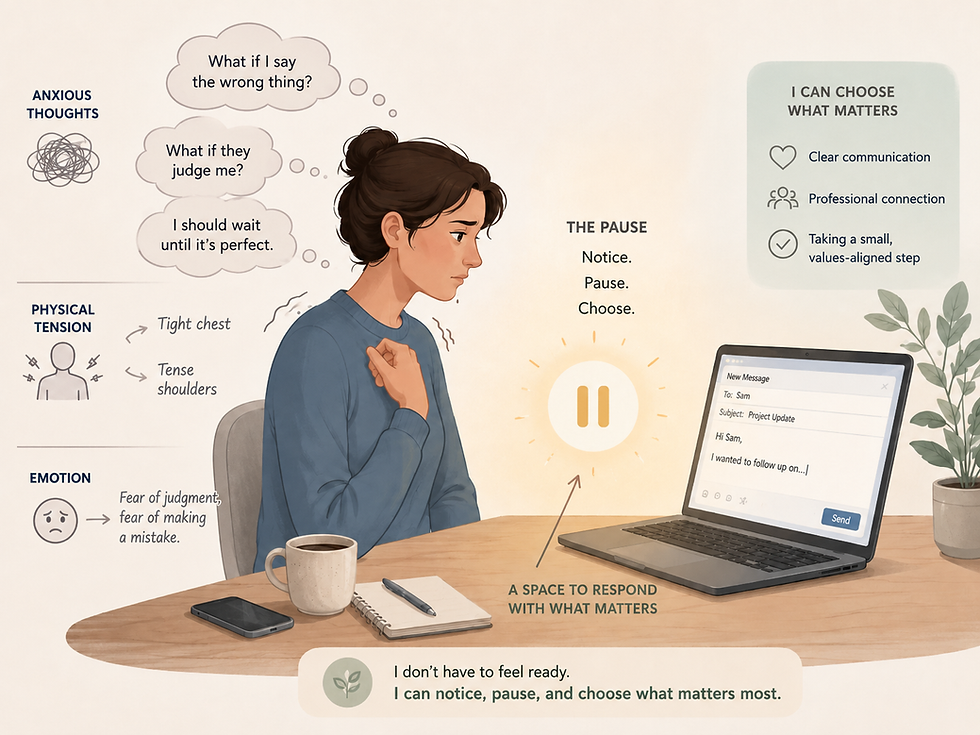
My work is grounded primarily in Acceptance and Commitment Therapy (ACT) and focuses on practical psychological skills: understanding the patterns that keep you stuck, learning to work differently with difficult thoughts and emotions, and moving towards what matters in real life.
I completed my professional psychotherapy training in Ireland and am a member of IAHIP, ICP and BACP.
If you are an expat or international professional looking for therapy and would like to understand more about how I work, you can also read my article on noticing feelings, emotions and sensations, which explores how psychotherapy can help us move from automatic reactions towards more intentional action.
Or, if you would like to explore whether working together might be a good fit, you are welcome to get in touch and start with an introductory conversation.


Comments