


How ACT Fits Within CBT: Understanding Thoughts, Feelings and Behaviour

If you are looking for help with anxiety, overthinking or OCD, the names of different therapies can quickly become confusing. One therapist offers cognitive behavioural therapy (CBT), another uses Acceptance and Commitment Therapy (ACT), and someone else recommends exposure and response prevention (ERP).
These can sound like three competing options. Yet they overlap.
ACT fits within CBT as one of its approaches. More specifically, it belongs to the broader family of cognitive behavioural therapies and is commonly described as a third-wave, contextual behavioural approach (Hayes, 2004). Understanding that relationship can help you ask clearer questions about therapy and what you might actually do in sessions.
How ACT Fits Within CBT
CBT has two common meanings. Sometimes it refers to the whole family of therapies that draw on research into learning, thinking and behaviour. Sometimes it means a particular approach, especially cognitive therapy associated with Aaron Beck.
That second meaning often brings to mind identifying unhelpful thoughts, examining the evidence and developing a more balanced perspective. Those methods are part of CBT, but they do not define everything within the family (Guarna, n.d.).
ACT shares CBT’s behavioural foundations. It explores how patterns develop, what keeps them going and how new responses can be learned. It also works directly with thoughts, emotions and the rules we follow about ourselves.
For example, you might believe you must feel confident before contributing in a meeting. Staying silent brings immediate relief, but it may gradually restrict your participation and reinforce the habit of withdrawing.
An ACT therapist would explore that pattern with you and help you practise responding differently. Understanding matters, and so does what becomes possible outside the therapy room (Association for Contextual Behavioral Science [ACBS], n.d.-a).
What does third-wave CBT mean?
The three waves are a useful historical shorthand:
Development within CBT | Main emphasis |
First wave: behavioural therapies | Understanding learned patterns and changing behaviour through methods such as exposure and reinforcement. |
Second wave: cognitive therapies | Giving greater attention to beliefs, interpretations and thinking patterns alongside behavioural change. |
Third wave: contextual and related approaches | Exploring how we relate to thoughts and emotions, with greater emphasis on acceptance, mindfulness and context. |
ACT belongs within that third grouping. The waves overlap: newer approaches continue to use methods developed earlier. The label does not mean that one wave is automatically better than another (Hayes, 2004).
For someone seeking therapy, the practical question is how an approach helps you understand your difficulties and make changes that matter in your life.
How ACT works with difficult thoughts
Imagine that you have moved to a new country and want to build friendships. Before a social event, your mind predicts that you will struggle to speak and other people will find you awkward.
A therapist using cognitive restructuring might help you examine that prediction, consider alternative explanations and test your expectations through experience.
An ACT therapist might focus on how the prediction influences your next step. Do you cancel? Spend hours rehearsing? Attend but remain absorbed in monitoring yourself?
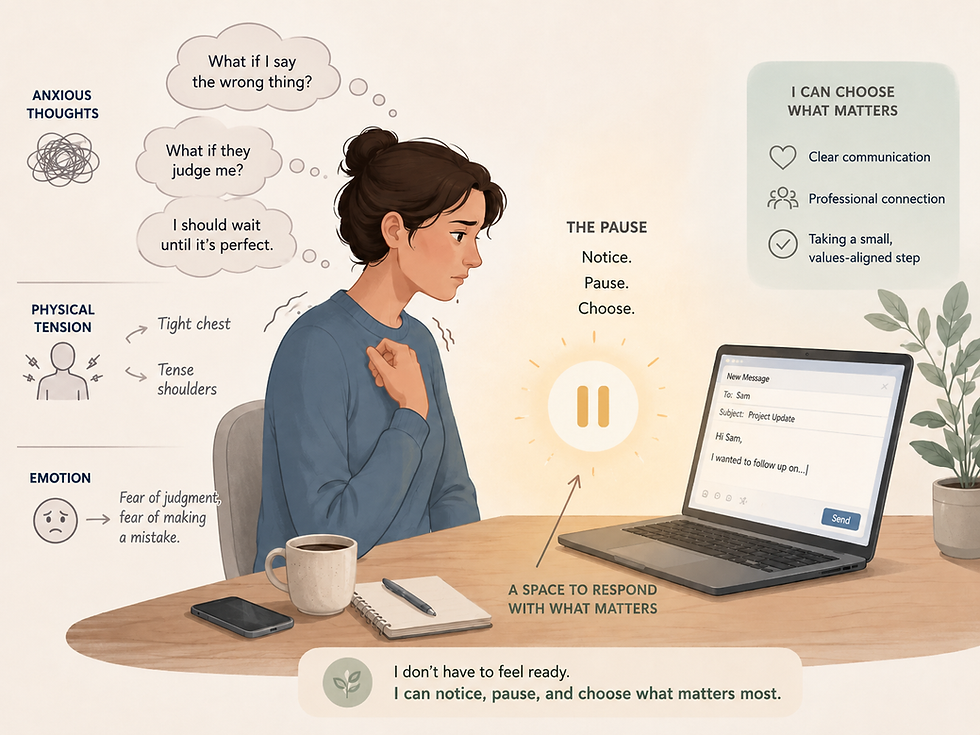
One ACT skill is cognitive defusion: noticing a thought as a mental event, so you have more room to choose how to respond (ACBS, n.d.-b). In this example, you might recognise a familiar prediction about rejection, notice the anxiety it brings and return your attention to the person in front of you.
The thought may still feel convincing. You can nevertheless introduce yourself or ask a question because connection matters to you.
This illustrates a difference in emphasis. Contemporary CBT includes many ways of working with thoughts and behaviour, and an individual therapist’s practice may draw on several of them (Guarna, n.d.).
Psychological flexibility: the central aim of ACT
ACT calls the capacity it develops psychological flexibility. In everyday language, this means being more aware of what is happening, more open to your internal experience and more able to choose actions that serve what matters to you (ACBS, n.d.-b).
That could mean raising a concern at work while feeling nervous, setting a boundary while guilt is present, or making a decision without first achieving complete certainty.
Acceptance has a specific meaning here: allowing room for difficult feelings when fighting them is making life harder. It does not require approving of harmful circumstances or abandoning efforts to change them.
You may need to address an unreasonable workload, leave a damaging situation or ask for support. Psychological flexibility includes recognising when your circumstances need to change (ACBS, n.d.-a).
Wanting relief is entirely understandable. ACT takes suffering seriously, while helping you build a life that is less dependent on first feeling calm, confident or certain.
Exposure shows how ACT and CBT connect
Exposure is one practical example of ACT’s behavioural roots. It involves planned contact with experiences you fear or avoid, creating opportunities to learn and respond differently.
Some approaches have emphasised habituation, the reduction in fear that can occur with repeated or sustained contact. However, modern exposure therapy also draws on inhibitory learning: developing new learning that competes with established fear associations. Craske et al. (2014) emphasise testing expectations and varying practice, rather than treating an immediate drop in anxiety as the main measure of success.
ACT organises exposure around psychological flexibility and meaningful action (ACBS, n.d.-b). For the person seeking friendships, that might involve attending an event, making room for discomfort and practising genuine participation.
Progress could include staying engaged in a conversation even when anxiety remains. The therapist still pays attention to distress, pacing and what the person is learning.
These perspectives can overlap. ACT offers a way of guiding exposure within CBT; it does not sit outside the behavioural tradition.
Where does ERP fit, particularly for OCD?
Exposure and response prevention (ERP) is a well-established CBT treatment for OCD. Exposure means approaching situations, thoughts or other triggers associated with obsessions. Response prevention means practising refraining from the compulsions used to respond to them (International OCD Foundation, n.d.).
Compulsions can be visible, such as repeated checking, or mental, such as repeatedly reviewing an event to gain certainty.
Consider an illustrative example: someone repeatedly rereads an ordinary work email because they fear having caused offence. A therapist might help them develop a plan to send emails while reducing ritualised checking and reassurance seeking. The plan would reflect their particular difficulties and ordinary work requirements.
ACT can be integrated into this work. Defusion may help the person notice an alarming thought, acceptance may support willingness to experience uncertainty, and values may connect practice with being more present at work or with family.
ACT combined with ERP offers a way to work on OCD while keeping your life goals at the centre of treatment. You practise facing triggers without performing compulsions, alongside learning to make room for difficult thoughts and feelings and move towards what matters to you. In a randomised trial, this combined approach produced substantial improvements that lasted through six-month follow-up. Although adding ACT did not demonstrate better outcomes than ERP alone, the findings support ACT and ERP being used together effectively (Twohig et al., 2018).
What this means when choosing a therapist
The labels provide a starting point, but it helps to ask what treatment will look like:
How will we understand the patterns keeping me stuck?
What skills or changes will I practise between sessions?
How will we decide whether therapy is helping?
If OCD is part of the picture, how will we address rituals, reassurance seeking and avoidance?
You can also explain what has happened in previous therapy. Perhaps examining your thoughts was useful. Perhaps you understood them intellectually but still found yourself repeating the same behaviour. That information can help shape the work.
In my practice, ACT provides a framework for exploring these patterns and building practical psychological skills. We look at the situations you face, the responses that have become familiar and the changes you want to make.
The connection between ACT and CBT matters because it makes the work easier to understand: ACT combines attention to thoughts and feelings with active learning and behaviour change. Its particular emphasis is helping you respond more flexibly and take meaningful steps, including when discomfort is present.
I offer therapy in English and Italian, in Paris and online. If you would like to explore whether this approach fits what you are experiencing, you are welcome to get in touch through Self Discovery Ways for an introductory conversation.
References
Association for Contextual Behavioral Science. (n.d.-a). About ACT. https://contextualscience.org/about_act
Association for Contextual Behavioral Science. (n.d.-b). The six core processes of ACT. https://contextualscience.org/six_core_processes_act
Craske, M. G., Treanor, M., Conway, C. C., Zbozinek, T., & Vervliet, B. (2014). Maximizing exposure therapy: An inhibitory learning approach. Behaviour Research and Therapy, 58, 10–23. https://doi.org/10.1016/j.brat.2014.04.006
Guarna, J. (n.d.). Comparing ACT and CBT. Association for Contextual Behavioral Science. https://contextualscience.org/comparing_act_cbt
Hayes, S. C. (2004). Acceptance and commitment therapy, relational frame theory, and the third wave of behavioral and cognitive therapies. Behavior Therapy, 35(4), 639–665. https://doi.org/10.1016/S0005-7894(04)80013-3
International OCD Foundation. (n.d.). Exposure and response prevention (ERP). https://iocdf.org/about-ocd/treatment/erp/
Twohig, M. P., Abramowitz, J. S., Smith, B. M., Fabricant, L. E., Jacoby, R. J., Morrison, K. L., Bluett, E. J., Reuman, L., Blakey, S. M., & Ledermann, T. (2018). Adding acceptance and commitment therapy to exposure and response prevention for obsessive-compulsive disorder: A randomized controlled trial. Behaviour Research and Therapy, 108, 1–9. https://doi.org/10.1016/j.brat.2018.06.005


Comments