


What Is ACT Therapy? A Practical Explanation for Real Life
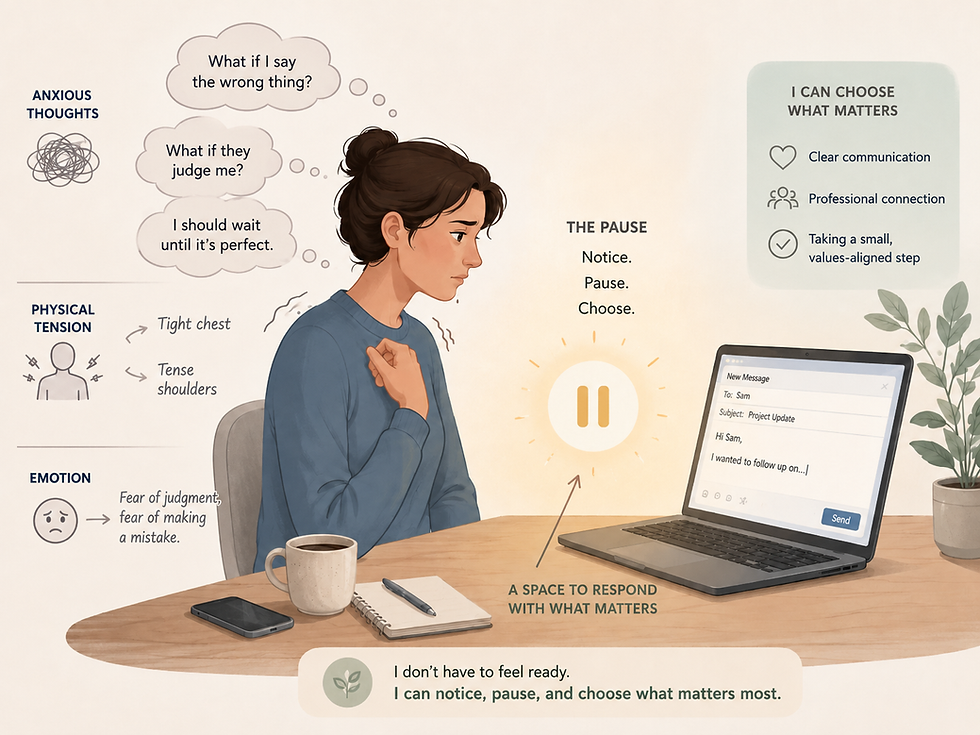
You open your laptop to answer an important email.
It should not take long. But before you begin, you notice a familiar reaction. Your chest feels a little tight. Your shoulders tense. Your mind starts producing uncomfortable predictions:
“What if I say the wrong thing?”
“What if they judge me?”
“What if I make the situation worse?”
You type a sentence. Delete it. Read the email again. Check your phone. Then you tell yourself you will come back to it later, when you feel clearer.
For a short while, you feel relieved.
But later that evening, the email is still there. The anxiety has not disappeared. It has simply been joined by frustration, guilt, and the familiar thought: “Why do I keep doing this?”
This kind of moment — where your best intentions meet your automatic coping patterns — is where ACT therapy can become very useful.
Not as an abstract psychological theory, but as a practical therapy approach for the real situations where life becomes stuck.
What Actually Is ACT Therapy?
ACT stands for Acceptance and Commitment Therapy. It is usually pronounced like the word “act,” rather than the letters A-C-T.
ACT is an evidence-based form of psychotherapy that focuses on building psychological flexibility.
In simple terms, psychological flexibility means developing the ability to stay present, notice your thoughts and feelings more clearly, and choose actions that are guided by your values — even when difficult emotions are present.
A simple way to understand ACT in daily life is this:
[Trigger] ➔ [Notice the Automatic Loop] ➔ [Insert a Pause] ➔ [Choose Values-Based Action]
ACT helps you become more aware of the patterns that shape your life. You begin to notice your thoughts, emotions, body sensations, urges, and habits. As this awareness grows, you can start to slow down automatic reactions and create more space to choose how you want to respond.
As an Italian and English-speaking ACT therapist in Paris, this is the practical approach I use with clients every day. The goal is not simply to understand why we struggle, but to develop psychological skills that help us respond differently in the situations we face in everyday life.
ACT Therapy Starts With “What,” Not Only “Why”
When people first come to therapy, they often ask a very understandable question: “Why am I like this?”
Why do I avoid hard conversations?
Why do I overthink a simple message?
Why do I lose patience with the people I care about?
These questions matter. Our past, our relationships, our nervous system, and our life experiences all shape how we respond today.
But insight alone is often not enough.
You may understand why you fear criticism and still avoid sending an important email. You may know why you tend to please others and still say “yes” when you are already exhausted.
ACT therapy does not ignore your history. But it also brings attention to what is happening in your life now. It asks a very practical question:
“What is happening right now, and is this response helping you live the life you want?”
The Puzzle Metaphor
Think of your life as a jigsaw puzzle.
To begin working with the puzzle, you do not need to know everything about why the picture was taken or the photographer's biography. You need to look at the pieces in front of you: their shapes, colors, edges, and how they connect.
ACT helps you look at the pieces of your present experience: your thoughts, emotions, body sensations, habits, relationships, and values.
The goal is not to judge these pieces. The goal is to see them more clearly, so that you can begin to work with them differently.
Step 1: Mapping Your Automatic Loops
We often like to believe that we make calm, conscious decisions throughout the day. In reality, many of our responses happen automatically.
A thought appears.An emotion follows.The body reacts.A familiar habit takes over.
The Trigger | The Internal Reaction | The Automatic Habit | The Long-Term Cost |
A difficult work email | “I’ll get this wrong.” Anxiety, tight chest | Delay the reply, check social media, avoid the task | More pressure, self-criticism, loss of confidence |
A child refusing bedtime | “I can’t deal with this.” Frustration, heat in the body | Raise your voice | Guilt, disconnection, bedtime becomes more stressful |
A partner’s sigh | “They are upset with me.” Fear, tension | Withdraw, go quiet, shut down | Emotional distance, unresolved conflict |
These habits are not random. They often have a short-term function. Avoiding the email reduces anxiety for a while. Raising your voice may decreae a fear of lack of control. Withdrawing may protect you from feeling rejected.
But over time, these patterns can also shrink your life.
ACT therapy helps you notice these loops while they are happening. Instead of seeing procrastination, anger, or withdrawal only as “problems,” you begin to see them as coping strategies that may have become costly.
Step 2: Buying Back Your Choice With a Pause
Once you learn to notice the loop, something important becomes possible: a pause.
Without a pause, the reaction can feel automatic. Your child refuses bedtime, and you snap. Your boss asks for a favor, and you say yes before checking whether you have the time or energy.
ACT does not try to remove anxious thoughts or difficult feelings. That would not be realistic. Instead, ACT helps create enough space between the feeling and the action, so that the feeling does not automatically decide what you do next.
In that pause, you might notice:
“Here is the thought that I am going to fail.”
“My chest feels tight. Anxiety is here.”
“I have a strong urge to close the laptop. Will that help me in the longer term?”
This is one of the most practical parts of therapy. You may still feel anxious, angry, ashamed, or uncertain. But you begin to relate to those experiences differently.
You are not trying to feel perfectly calm before acting. You are learning to act with more awareness, even when discomfort is present.
Step 3: Learning to Ride the Emotional Wave
One reason we stay stuck in unhelpful habits is that certain emotions can feel very hard to tolerate.
Guilt, shame, vulnerability, sadness, anger, and anxiety can feel overwhelming in the body. When those emotions appear, it is understandable that we want to escape, fix, numb, avoid, or control them.
This brings us to a central part of Acceptance and Commitment Therapy.
Acceptance does not mean resignation. It does not mean liking the discomfort, giving up, or allowing people to treat you badly.
In ACT, acceptance means making room for difficult internal experiences when fighting them is making life smaller. It means learning to carry discomfort in the service of something meaningful.
If every difficult emotion becomes a stop sign, your world can become very limited.
For example:
If you want a deeper relationship, you may need to make room for vulnerability.
If you want to grow professionally, you may need to make room for uncertainty or self-doubt.
If you want to set healthy boundaries, you may need to make room for guilt when you say “no.”
ACT helps you learn that an emotional wave can be strong without needing to control your behaviour.
A useful sentence might be:
“I can feel this discomfort and still choose my response.”
Step 4: Turning Values Into Daily Actions
ACT is not only about coping with difficult feelings. It is also about building a meaningful life.
This is where values-based action becomes important.
People often confuse goals and values, but they are different.
A goal is something you can complete, such as “get a promotion,” “run a marathon,” or “buy a house.”
A value is an ongoing direction, such as “being dependable,” “living with courage,” or “building connection.”
You can complete a goal. But you never complete being a caring parent, a reliable friend, or an honest partner. Values are directions you can return to again and again.
ACT helps turn values into concrete actions.
[Value: Connection] ➔ [Action: Put the phone away during dinner.]
[Value: Courage]    ➔ [Action: Send the email without rewriting it ten times.]
[Value: Self-Care]  ➔ [Action: Say no to an extra commitment, even if guilt shows up.]
This is where therapy becomes practical. Values are not only ideas we talk about in a session. They become small, real-life choices: how you speak, how you pause, how you repair, how you set limits, and how you move toward what matters.
Summary: The 5-Step ACT Checklist for Real Life
If you want to apply ACT principles in daily life, you can begin with these five questions whenever you feel stuck:
What is happening right now? Look at the situation as clearly as possible, without adding too much story around it.
What can I notice internally? Name your thoughts, emotions, body sensations, and urges.
Can I slow down? Take one breath. Create a small space between the trigger and your response.
Can I make room for this feeling? Allow the anxiety, guilt, anger, or sadness to be present without immediately trying to fix, avoid, or numb it.
What values-based action matters now? Ask yourself: What would help me move toward the kind of person I want to be in this situation?
Real Life, Not Textbook Perfect
ACT therapy does not promise a life without anxiety, anger, self-doubt, or stress. That would not be real life.
You may still feel anxious before sending an email. You may still lose patience with your children. You may still avoid something important from time to time.
The goal of ACT is not perfection.
The goal is to build enough awareness, emotional capacity, and psychological flexibility that when you notice yourself moving away from what matters, you can gently return.
Again and again, in small practical ways, you learn to pause, make room for what is difficult, and choose a response that is more aligned with the life you want to live.
If this way of working resonates with you, you're welcome to book a call with me. Together we can explore what is happening in your life, the patterns that may be keeping you stuck, and whether ACT therapy feels like the right approach for you.


Comments